
WooHub
One central cockpit for faster, more transparent Woo requests
During the Open Government Hackathon “Terminal WOO” (31 October and 1 November 2025), the Fokker Terminal in The Hague became a makerspace for two days focused on one question: how can the internal Woo process work better for civil servants? Ten teams rapidly built solutions to support and speed up the search, review and disclosure of information. (Read more at ecp.nl.)
Techletes was selected to take part and formed a team with Oggel Codelabs (modern, scalable web apps) and PAQT (front end). In 1.5 days, we developed a working prototype: WooHub, a central platform that brings overview, task management and transparency together in one environment.
Terminal WOO is part of the Digitaal Doordacht program, in which the Ministry of the Interior and Kingdom Relations (BZK), through its Open Government program, and ECP | Platform for the Information Society are working together towards a future-ready digital government.
The challenge
The Dutch Open Government Act is intended to increase transparency, but handling requests often takes a great deal of time and coordination in practice. Our pitch started with a hard fact: an average Woo request takes 188 days, although it should take 42 days; only 17% are handled on time, and the requester is consulted in only a quarter of cases. This frustrates the public, increases the workload for civil servants and undermines trust.
At the same time, we saw that the process can be faster. Amsterdam’s approach, with best practices that helped halve turnaround time, is inspiring, but it is not yet scalable for every organization. That is exactly what we wanted to address at the hackathon.
Our solution: WooHub
WooHub is a central hub for managing Woo requests: one place where the case manager receives a request, assigns tasks, monitors deadlines and shares progress with everyone involved. Instead of scattered emails, spreadsheets and ad hoc handovers, everyone works from the same “cockpit”.
The principle is simple: the case manager stays in control, while the platform automates what it can. Deadlines are monitored, colleagues receive automatic reminders about outstanding tasks, submitted documents are analyzed automatically, and requesters and stakeholders stay informed.
Demo: the journey of a Woo request
Step 1 – The request reaches the case manager
A new Woo request starts in WooHub. The case manager can immediately see who made the request, what they are asking for and the legal deadline. From the same screen, the case manager gets in touch to clarify the question behind the question; in practice, that early conversation helps get to the heart of the matter faster.
Step 2 – Collecting documents without the hassle
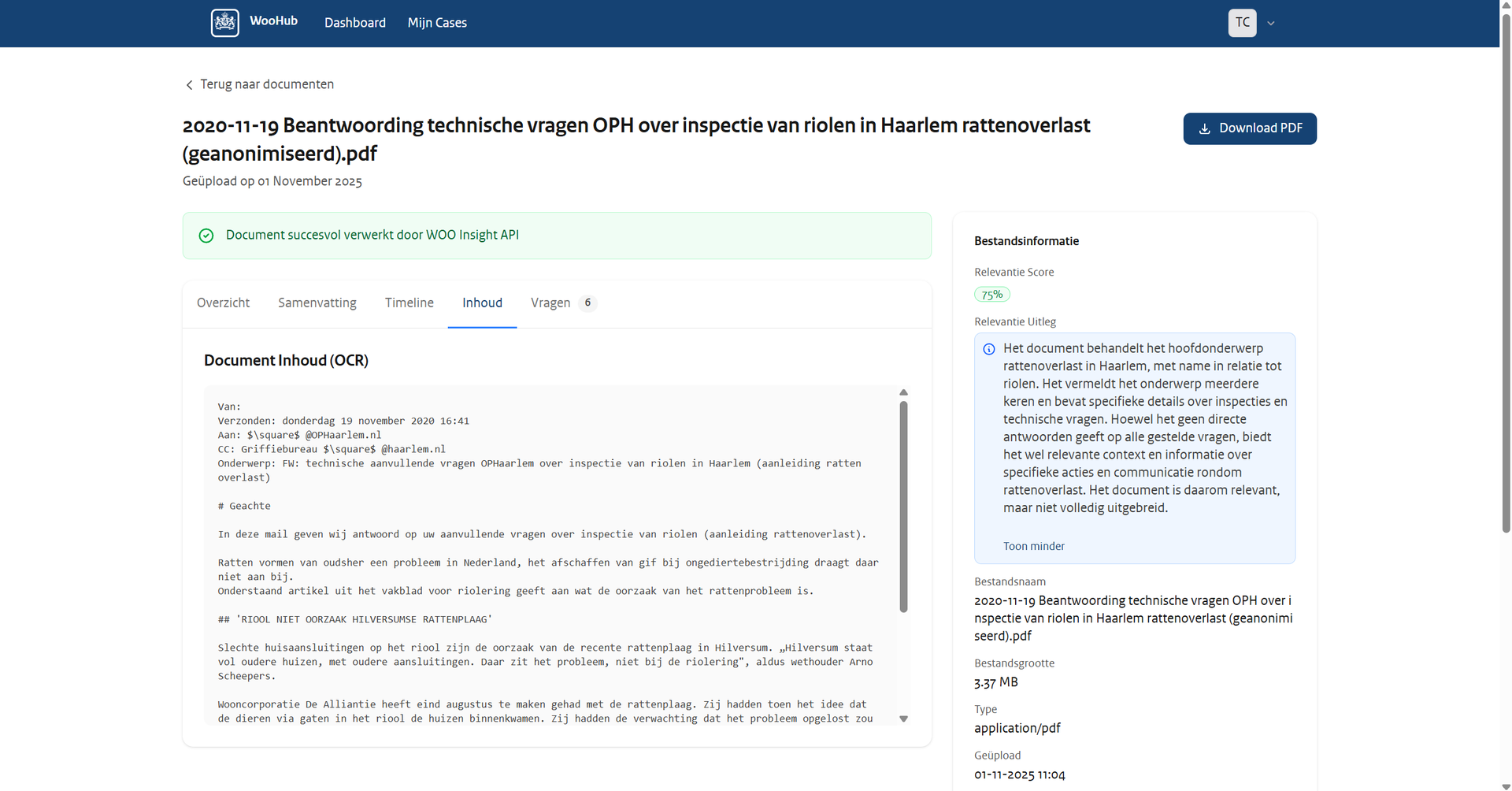
The case manager then assigns tasks to colleagues. They receive a clear invitation and upload the requested documents through the portal. As soon as documents arrive, WooHub converts them into machine-readable text, creates summaries and automatically builds an inventory. It also creates a timeline of the information in the documents, making it quicker to see where things are mentioned.
Step 3 – Overview and priorities in one cockpit
The case manager monitors progress on the dashboard: who has submitted materials, which tasks are still open and where delays are emerging. AI also assigns each document in the inventory a priority, so the most relevant materials can be reviewed first and the key information can move towards disclosure or a response sooner.
Step 4 – Transparency for the requester
What sets WooHub apart is that the requester can see that same progress. The citizen or journalist can see which steps have been taken and even indicate which documents are most important to receive quickly. The Woo process becomes a conversation between requester and civil servant, rather than a black box.
Intelligent AI document processing: from volume to meaning
A crucial part of WooHub, and one of the areas where we made the biggest difference during the hackathon, is AI-powered document processing. An average Woo request can involve dozens or even hundreds of documents. Traditionally, this means reading, searching, summarizing, comparing and manually deciding what is relevant. WooHub takes on precisely this heavy work.
As soon as colleagues upload documents to WooHub, they are processed automatically. AI reads the files and converts them into structured, machine-readable information. A disorganized pile of documents becomes a dataset that can be analyzed and used directly by the case manager.
First, WooHub automatically builds a timeline of events. It identifies key moments in each document and places them in chronological order with context: what happened, who was involved, where it took place and what the event means. This gives an at-a-glance view of how a case developed over time, without requiring every document to be read in full.
Each document also receives a relevance score in relation to the submitted Woo request. AI compares document contents with the questions and subject of the request. The case manager can quickly see which materials are most likely to contribute to the response and which have lower priority. This helps the team focus instead of working through everything in sequence.
Based on the same analysis, WooHub generates a decision-making report. It brings together the key insights from all documents: which information is decisive, where potential sensitivities lie and how the materials relate to one another. The report supports civil servants in making informed disclosure decisions without automating the decision itself.
Finally, WooHub automatically links documents to the specific questions in the Woo request. For each question, the system shows which documents are relevant and which passages contain information that contributes to an answer. This makes complex, multi-part requests easier to manage and helps ensure information is not overlooked.
Together, these AI features shift document processing from a time-consuming manual task to an intelligently supported process. Civil servants stay in control while gaining structure, context and priorities, all of which help them handle Woo requests faster, more carefully and more transparently.
The WooHub platform
WooHub is designed as a foundation that organizes the process: tasks and priorities are managed centrally, the process becomes radically transparent and the requester is actively involved from the start. This makes collaboration easier and can save a great deal of work by keeping attention on what really matters. In our pitch, we linked this to potential savings of up to 80% through smart prioritization in consultation.
WooHub is also modular. Other smart tools, including solutions built during the hackathon, can plug into one central hub while WooHub maintains oversight and automation is expanded step by step.
Curious what we could do for your organization?
At Techletes, we help organizations get to grips with complex data and information challenges. Whether the goal is transparency, document processing, AI-supported decision-making or a scalable platform, we turn technological possibilities into practical solutions that work.
Curious what this approach could look like for your challenge?
Get in touch; we would be happy to think it through with you.